Friday November 28, 2008
Pak Lah: Civil servants can go back to pension scheme
By SIM LEOI LEOI
PUTRAJAYA: Some 40,000 civil servants, who had opted for the Employees Provident Fund, can now revert to the pension scheme.
Prime Minister Datuk Seri Abdullah Ahmad Badawi said these civil servants can exercise their option to revert to the pension scheme in January.
“Their decision will take effect from Feb 1, and they will be able to enjoy all the facilities currently entitled to pensioners, such as free medical treatment. Parents of civil servants, who have passed away and were single at that time, will also receive ex-gratia payments.
“These are some of the decisions that were made following a recent meeting by the Cabinet committee on appointments and salaries for civil servants,” he said in his speech before presenting the Public Sector Quality Awards at the Putrajaya International Convention Centre here yesterday.
Other decisions taken by the committee included upgrading the salary schemes for investigating officers under the Anti-Corruption Agency and for senior, low-ranking officers and constables in the police force, and a 20% increase in pay for maritime officers.
“All these decisions will be effective from Jan 1,” he said, adding that the Government would work out the actual amount of financial allocation involved in the upgrading and salary increase later.
Cuepacs welcomed the move to allow civil servants on the EPF scheme to opt for the pension scheme, said its secretary-general Ahmad Shah Mohamad Zain.
Last week, Cuepacs president Omar Osman complained that civil servants who opted for EPF scheme did not enjoy benefits such as free medical treatment in government hospitals and gratuity payments upon their retirement.
The Star
The reason for allowing civil servants to choose the EPF sccheme was to reduce the government's long term liability for future pension payments. Now that all the civil servants who chose to be in the EPF scheme are allowed to go back to the pension scheme, has there been any calculation on how much more the government need to pay for the pensions? There should be some figures given on the long term liabilities calculated by qualified actuaries.
The idea of allowing civil servants to opt for the EPF scheme has many advantages. It allows for freer movements of civil servants to the private sector. It also protects civil servants who might run foul of the law and get their pensions cancelled. The retirees also will get one lump sum payment on retirement and if the money is managed properly will result in a prosperous retirement.
The disadvantages of the EPF scheme could be easily overcome to allow the civil servants who choose the EPF scheme to enjoy similar benefits to those who choose the pension scheme. The same medical benefits and other related benefits given to those who choose the pension scheme could be given to those who choose the EPF scheme.
The amount of money withdrawn at retirement could be increased if the contribution of the government to EPF for each employee could be increased from the current 12% to 17.5%. This would not increase the government's expenses because, as it is, the government has to contribute an amount equal to 17.5% of each employee's salary to the Kumpulan Wang Amanah Pencen for every employee who choose the pension scheme.
Friday, November 28, 2008


Tuesday, October 28, 2008
Muslim Gold Standard
http://www.worldfutures.info/Analysis/Islamic-World/Islamic-World-Wither-a-Muslim-Gold-Standard.html
Islamic World: Wither a Muslim Gold Standard?
Written by Kazi Mahmood
Saturday, 25 October 2008
The last few times we heard of the Muslim world using Gold to replace currency was during the time of Prime Minister Tun Mahathir's reign. He was sure and certain that Gold cold bring the downfall of the paper money era.
Since then, the idea fizzled amid a few attempts at promoting Gold itself as a currency and as a means to make payments internationally. The business of gold minting in Malaysia, which started with a few companies minting gold for sale locally, went bust.

A type of Gold Dinar from UK
One wonders how doing business with gold can go bust but it is a reality in Malaysia since the people involved in the business were after the quick profit, not after the long haul of becoming rich and solid after years of patience and perseverance.
Though it is relevant to sell gold coins, it must be done with much publicity and the right approach. Trying to impose gold as the currency to be carried around does not work in the modern age. People need cards, gold cards that can help carry thousands of dollars around like in credit cards. We are in the age of the digital money too, and the gold coins providers could shift their businesses more into the cyberspace.
Now what about the gold as Islamic currency?
During that period, writing for Islamonline.net, I suggested that we use gold as the standard, not as the currency necessarily and that this will mean backing the currency we use with pure, existing gold stocks. This idea did not take up since it does not bring ready, quick bucks to any of the would be investors in this business.
Now let me tell you about the US. The much hated and much criticized US governments over the years did one right thing. They used gold as the standard and created a unique type of gold currency investment.
This gold currency investment sores in price after gold prices rise. The profit can be huge and dramatically turn the investments into windfall gains, unexpected and much wanted.
How do they do it?
Everybody knows that gold is a safe investment in times of economic chaos--that's why the U.S. mint recently ran out of gold bullion coins to sell to investors (source: The Los Angeles Times).
The US print money, paper money, to pay for its follies and yet the more it prints, the better it is for Gold prices. In that case, you do not need to own gold itself to earn the benefits of the current US policies. What you need is follow the price of gold on the market and invest in gold currencies that exists for decades in the US.
What about the Islamic world?
What the Mahathir followers in the gold coins business failed to understand is how to use a gold standard system to back the Muslim world's currencies. What the US did was to back their currency with gold standards = the US remains one of the major gold hoarding nations on earth.
Simply follow the US principle and integrate gold in the modern currency system by backing one's entire currencies on gold would have created support for gold currency standards but no one will do that since there is no 'profit' to be made by 'brokers'. That is the real problem faced in the Muslim world and it has escaped the promoters of gold currencies in countries like Malaysia.
The question is will there be a gold standard for the Muslim world? There can be such a standard only if the Arab world with the Asians and Africans in the Organization of Islamic Conference (OIC) pushes for gold to become the standard currency to be used to back the existing paper money.
Its a long shot and it may not see the light not with this generation of Muslims anyway.
Islamic World: Wither a Muslim Gold Standard?
Written by Kazi Mahmood
Saturday, 25 October 2008
The last few times we heard of the Muslim world using Gold to replace currency was during the time of Prime Minister Tun Mahathir's reign. He was sure and certain that Gold cold bring the downfall of the paper money era.
Since then, the idea fizzled amid a few attempts at promoting Gold itself as a currency and as a means to make payments internationally. The business of gold minting in Malaysia, which started with a few companies minting gold for sale locally, went bust.
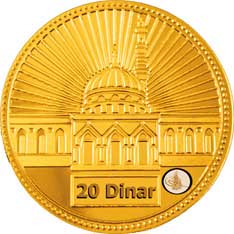
A type of Gold Dinar from UK
One wonders how doing business with gold can go bust but it is a reality in Malaysia since the people involved in the business were after the quick profit, not after the long haul of becoming rich and solid after years of patience and perseverance.
Though it is relevant to sell gold coins, it must be done with much publicity and the right approach. Trying to impose gold as the currency to be carried around does not work in the modern age. People need cards, gold cards that can help carry thousands of dollars around like in credit cards. We are in the age of the digital money too, and the gold coins providers could shift their businesses more into the cyberspace.
Now what about the gold as Islamic currency?
During that period, writing for Islamonline.net, I suggested that we use gold as the standard, not as the currency necessarily and that this will mean backing the currency we use with pure, existing gold stocks. This idea did not take up since it does not bring ready, quick bucks to any of the would be investors in this business.
Now let me tell you about the US. The much hated and much criticized US governments over the years did one right thing. They used gold as the standard and created a unique type of gold currency investment.
This gold currency investment sores in price after gold prices rise. The profit can be huge and dramatically turn the investments into windfall gains, unexpected and much wanted.
How do they do it?
Everybody knows that gold is a safe investment in times of economic chaos--that's why the U.S. mint recently ran out of gold bullion coins to sell to investors (source: The Los Angeles Times).
The US print money, paper money, to pay for its follies and yet the more it prints, the better it is for Gold prices. In that case, you do not need to own gold itself to earn the benefits of the current US policies. What you need is follow the price of gold on the market and invest in gold currencies that exists for decades in the US.
What about the Islamic world?
What the Mahathir followers in the gold coins business failed to understand is how to use a gold standard system to back the Muslim world's currencies. What the US did was to back their currency with gold standards = the US remains one of the major gold hoarding nations on earth.
Simply follow the US principle and integrate gold in the modern currency system by backing one's entire currencies on gold would have created support for gold currency standards but no one will do that since there is no 'profit' to be made by 'brokers'. That is the real problem faced in the Muslim world and it has escaped the promoters of gold currencies in countries like Malaysia.
The question is will there be a gold standard for the Muslim world? There can be such a standard only if the Arab world with the Asians and Africans in the Organization of Islamic Conference (OIC) pushes for gold to become the standard currency to be used to back the existing paper money.
Its a long shot and it may not see the light not with this generation of Muslims anyway.
Monday, October 6, 2008
BBA Financing
Wednesday, September 10, 2008
BBA: Banking sector braces for impact from ruling
By HABHAJAN SINGH
The Islamic banking fraternity is bracing to face a fallout from the recent High Court rulling that the application of the Al-Bai' Bithaman Ajil (BBA), a widely used Islamic home financing contract, is contrary to the Islamic Banking Act 1983.
At the heart of the written judgement by Datuk Justice Abdul Wahab Patail is that since some BBA contracts were structurally faulty, defaulters need not pay more than the original financing amount that they received, depriving banks of the profit that they would have otherwise booked from the transaction.
Bankers also fear the judgement could mean that current BBA financing clients would only need to pay the facility amount and would escape from paying the profit portion.
The home financing facilty extended under the BBA concept runs into billions of ringgit. "It will impact (the industry) in a big way. Bankers and financiers are used to the idea that when a default takes place, they are entitled to recover the full balance of the sales price. This and the previous judgement by Justice Wahab has altered that," said a local lawyer who ranks among the pioneers in the field of Islamic finance.
Wahab's latest judgement, dated July 18, encompassed 11 separate cases involving Bank Islam Malaysia Bhd and Arab-Malaysian Finance Bhd as the plantiffs.
It is understood that the banks are appealing to the Court of Appeal to overturn the judgement which was received by lawyers involved in the case only last month.
Industry experts estimate that close to 70% of Islamic financing has been granted under the BBA concept which essentially is a deferred payment sale (the sale of goods on a deferred payment basis) at an agreed selling price, which includes a profit margin agreed on by the customer and the bank.
The BBA concept is widely used in various Islamic financing instruments, including for bridging finance, cash line facilities, contract financing, project financing and letters of credit.
Among the big local players on this front are CIMB Bank Bhd, Malayan Banking Bhd, Bank Islam Malaysia Bhd and Public Bank Bhd, all of whom have home financing facilities based on the BBA concept. Local banks like CIMB and Maybank now have full-fledged Islamic subsidiaries that handle such financing.
"Banks are worried this judgement will set off alarm bells with regard to confidence with BBA locally. As for foreign investors, they fear its potential ramification on Malaysia's efforts in becoming a global hub for Islamic finance.
"Our whole industry has been BBA-driven. Banks are fervently trying to find a solution," said an industry executive.
It is understood that the legal departments of some these banks are now trying to get their hands on Abdul Wahab's latest judgement which has yet to be published by any of the local regular sources for the legal fraternity.
On Monday, The Malaysian Reserve ran a report on Abdul Wahab's ruling followed by excerpts from the 54-page judgement the next day.
The judgement on the appplication of BBA, popular at home but much criticised abroad, is set to be another widely discussed judgement after Abdul Wahab's earlier ruling in the case of Affin Bank Bhd vs Zulkifli Abdullah, in which he passed a ruling on the calculation of the amount to be paid in the event of a foreclosure.
The 2006 case attracted much attention, and is still the subject of seminars today, as it turned on its head the way bank practitioners calculated the outstanding amount to be repaid by borrowers who had defaulted on their BBA contracts.
Some banks had calculated the amount up to the full period of the facility, even though the borrowers may have defaulted only a few years into the financing. to be fair, though, banks usually have a defaulter rebate, which is at their sole discretion.
"The effect of this judgement is that customers are obliged to pay only the principle that had been extended to them.
"Since the court holds this contract null and void, Section 66 of the Contract Act will apply," said a lawyer. Section 66 of the act states that "when an agreement is discovered to be void, or when a contract becomes void, any person who has received any advantage under the agreement or contract is bound to restore it, or to make compensation for it, to the person from whom he received it."
(The Malaysian Reserve, Sept 11, 2008)
Posted by HABHAJAN SINGH at Wednesday, September 10, 2008
Labels: Bank Islam, BBA, Islamic finance, judiciary
BBA: Banking sector braces for impact from ruling
By HABHAJAN SINGH
The Islamic banking fraternity is bracing to face a fallout from the recent High Court rulling that the application of the Al-Bai' Bithaman Ajil (BBA), a widely used Islamic home financing contract, is contrary to the Islamic Banking Act 1983.
At the heart of the written judgement by Datuk Justice Abdul Wahab Patail is that since some BBA contracts were structurally faulty, defaulters need not pay more than the original financing amount that they received, depriving banks of the profit that they would have otherwise booked from the transaction.
Bankers also fear the judgement could mean that current BBA financing clients would only need to pay the facility amount and would escape from paying the profit portion.
The home financing facilty extended under the BBA concept runs into billions of ringgit. "It will impact (the industry) in a big way. Bankers and financiers are used to the idea that when a default takes place, they are entitled to recover the full balance of the sales price. This and the previous judgement by Justice Wahab has altered that," said a local lawyer who ranks among the pioneers in the field of Islamic finance.
Wahab's latest judgement, dated July 18, encompassed 11 separate cases involving Bank Islam Malaysia Bhd and Arab-Malaysian Finance Bhd as the plantiffs.
It is understood that the banks are appealing to the Court of Appeal to overturn the judgement which was received by lawyers involved in the case only last month.
Industry experts estimate that close to 70% of Islamic financing has been granted under the BBA concept which essentially is a deferred payment sale (the sale of goods on a deferred payment basis) at an agreed selling price, which includes a profit margin agreed on by the customer and the bank.
The BBA concept is widely used in various Islamic financing instruments, including for bridging finance, cash line facilities, contract financing, project financing and letters of credit.
Among the big local players on this front are CIMB Bank Bhd, Malayan Banking Bhd, Bank Islam Malaysia Bhd and Public Bank Bhd, all of whom have home financing facilities based on the BBA concept. Local banks like CIMB and Maybank now have full-fledged Islamic subsidiaries that handle such financing.
"Banks are worried this judgement will set off alarm bells with regard to confidence with BBA locally. As for foreign investors, they fear its potential ramification on Malaysia's efforts in becoming a global hub for Islamic finance.
"Our whole industry has been BBA-driven. Banks are fervently trying to find a solution," said an industry executive.
It is understood that the legal departments of some these banks are now trying to get their hands on Abdul Wahab's latest judgement which has yet to be published by any of the local regular sources for the legal fraternity.
On Monday, The Malaysian Reserve ran a report on Abdul Wahab's ruling followed by excerpts from the 54-page judgement the next day.
The judgement on the appplication of BBA, popular at home but much criticised abroad, is set to be another widely discussed judgement after Abdul Wahab's earlier ruling in the case of Affin Bank Bhd vs Zulkifli Abdullah, in which he passed a ruling on the calculation of the amount to be paid in the event of a foreclosure.
The 2006 case attracted much attention, and is still the subject of seminars today, as it turned on its head the way bank practitioners calculated the outstanding amount to be repaid by borrowers who had defaulted on their BBA contracts.
Some banks had calculated the amount up to the full period of the facility, even though the borrowers may have defaulted only a few years into the financing. to be fair, though, banks usually have a defaulter rebate, which is at their sole discretion.
"The effect of this judgement is that customers are obliged to pay only the principle that had been extended to them.
"Since the court holds this contract null and void, Section 66 of the Contract Act will apply," said a lawyer. Section 66 of the act states that "when an agreement is discovered to be void, or when a contract becomes void, any person who has received any advantage under the agreement or contract is bound to restore it, or to make compensation for it, to the person from whom he received it."
(The Malaysian Reserve, Sept 11, 2008)
Posted by HABHAJAN SINGH at Wednesday, September 10, 2008
Labels: Bank Islam, BBA, Islamic finance, judiciary
Friday, August 15, 2008
A New Take on Riba
Interview: A new take on riba
01 July, 2008
Dr Azeemuddin Subhani spent nearly three decades working as a financial advisor in the Saudi oil ministry. Though he worked in a conventional financial environment, he nevertheless harboured a passion for Islamic finance and law. When he retired in 1999, he took the opportunity to study it at McGill University in Canada. He finished a PhD in Islamic Law and Finance in April 2007. He has since presented his thesis, in which he provides a new definition of the concept of riba, at Harvard Law School in the US, where it is currently being edited for publication. Dr Subhani has been publicising it for a couple of months now, in which time Sheikh Nizam Yaqubi, a prominent Shari’ah scholar, has offered to translate it into Arabic and distribute it to libraries across the Arabic world. Others have offered to translate it into Turkish and Urdu. Here, Dr Subhani explains to NewHorizon what he thinks the true meaning of riba is all about.
NewHorizon: What is the background of your thesis?
Dr Subhani: If you survey Islamic literature, you find that the whole question of the prohibition of riba has been dealt with at a very cursory level. None of the scholars have really gone into the depths of the issue as to what the real meaning of ‘riba’ is, and why there is such a strict idea of the prohibition of riba in the Quran. This sin is treated as the greatest of all sins, and the Quran lays down very graphic punishment for any human indulgence in riba. But nobody gives us an exact explanation as to why the financial or economic act of riba carries such characterisation as the greatest of sins. The Quran threatens humankind with eternal hellfire for those who indulge in any act of riba. So my question became, why? What is at stake here? Is riba just a financial and economic sin?
There are more serious economic crimes, but they do not attract such punishment in the Quran. If riba, or interest, is usurpation of wealth from the poor to the wealthy, at least there is consent from both parties. You can have a usurpation of the same wealth from poor to rich by fraud or deception, which is theft. But theft does not carry such serious punishment in the Quran. You can do even worse – you can rob by force, or by murder – but this most grievous of impacts on a fellow human being does not attract such serious punishment as riba does in the Quran.
The punishment is clearly out of line with the gravity of the perceived sin – perceived as it is as an economic or financial sin. This plainly goes to show, at least to me, that the act of riba is not solely an economic paradigm. It does not belong in that category.
So what is your answer for the discrepancy?
I asked myself, what is the intrinsic characteristic in the process of riba? For this I used a linguistic analysis of the Quran which has not been attempted before in this area. My conclusion is that, if you analyse the act of interest taking and some other verbal applications of riba in the Quran, you will find that the Arabic term ‘riba’ basically means growth from a process of self generation. ‘Riba’ is one agent acting on itself to produce growth. Money begetting money, as Aristotle might say, is the obvious example. Without the intervention of any other agent, money can just keep on growing. You just put it in a bank account, and even if the bank does nothing with that money, you can come back at the appointed time each month and collect the interest. That process theoretically can continue for an eternity.
It is this element of self generation which is the conspicuous characteristic underlying riba. When we talk of self generation, we are close to talking of self emanation, of self subsistence, and eventually eternity. And these ideas are absent in other economic crimes. This explains the discrepancy, and if you look at these attributes, they are clearly, and very obviously, divine attributes. They are not in the human gift.
Therefore, I submit that any human indulgence in any act of self generation, which includes interest taking, is a transgression of the divine domain. Any transgression in the divine domain is an act of shirk, an act of idolatry, an act of polytheism. And this is the only reason which can possibly explain why the Quran provides such graphic, otherworldly punishments for committing an otherwise worldly sin.
Is there anything else in the Quran that supports your definition?
Yes. This whole principle of self generation and intra-action by one agent on itself is well documented in Islamic tradition. There is a prophetic saying from the popular books of the Hadith such as Sahih Bukhari, which says that the sin of committing riba is worse than committing incest with one’s own mother. This Hadith is well received in Islamic tradition. But when scholars have been asked what this association of riba with incest means, they simply cannot explain beyond asking, ‘can’t you see the moral and ethical connotations? The Prophet is trying to create an extreme revulsion in you for the practice of riba.’
But look at it slightly more philosophically. Consider what is happening when a man commits incest with his own mother. A man is incapable of reproducing by himself, but if he commits incest with his own mother, he is coming as close as possible to becoming his own father, or fathering himself once again. The closest he can come to reproducing himself is to reproduce with the one who produced him in the first place. So the Prophet associates incest with riba to emphasise the extreme intra-activeness and self generation of the act of riba.
Any human indulgence in any act of self generation, which includes interest taking, is a transgression of the divine domain.
There is also another injunction in the Hadith, a prophetic saying which states that riba has 72 chapters and so does shirk, or idolatry. This saying establishes an equivalence between polytheism and riba, which scholars have included in their writings but never commented on.
There is more evidence if you look at the linguistic root of the word. The linguistic root of ‘riba’ is strikingly similar to that of ‘Rabb’. They are not the same but they are cognate roots. And ‘Rabb’ is the Arabic word for ‘Lord’. Moreover, nobody has commented on this but the Quran also declares riba to be ‘harrama’ (2:275). The Arabic verb ‘harrama’ in its emphatic form means, to prohibit something because it is out of bounds for you, or because it is sacred. So there is nothing intrinsically evil about riba. Yes, the practice of financial riba may have some evil effects of exploitation or injustice. But it may not in other cases. What this means is that it is not prohibited because it is an evil practice, but because it is a divine practice.
To contrast this, the practice of maysir, which is gambling, has not been declared harrama or sacred. It has simply been declared as something to be avoided because it is evil. Avoidance of gambling, which is the second foundation of Islamic finance, is not on the same religious or theoretical level as riba is. It is simply a satanic act. It has not been declared sacred like riba has.
So what impact would your definition of ‘riba’ have on Islamic banking?
When we restrictively translate ‘riba’ as interest/usury, we are narrowing the definition to a financial practice. When we analyse a financial document, we simply look for the presence of interest as such. And if there is no word ‘interest’ in the document, we are satisfied. We can declare that document to be Shari’ah-compliant. But under my more intrinsic definition, you have to look not just for interest but for any exchange of homogeneity, any exchange of homogeneous items in a business transaction where an increase is taking place. That exchange would also become riba. Any exchange of homogeneous items – money for money, commodity for similar commodity – if it involves an increase, would be under the sanction of riba.
My definition will establish the proper understanding of the concept of riba, and will explain the severity of commissioning riba. Nobody will be able to summarily dismiss it as purely a financial matter. Once you have this explanation, you’ll think twice about a dismissive reaction. But the definition will simplify the practice of Islamic finance. It will provide one guiding principle, which is that in order to look for riba you must look for any instance of self generation. That is riba, and you must stay away from it. What you shouldn’t do is get into a semantic debate about the definition of usury, what it used to be and what it is now. All that semantic debate leads nowhere. It doesn’t explain the theology of the concept. My definition gives a simple litmus test of what is riba and what is not.
Once you define riba in this broad sense, there are other acts of riba, not just financial ones. Human cloning is one act of biological riba. Incest is another easily identifiable example, the nearest one can come to self generation.
Why has the extant scholarship missed this concept?
The only plausible explanation is that scholars, especially modern scholars, have looked at the question of riba only by asking what the most likely financial practice was at the time of the revelation of the Quran. They have tried to connect all the prohibitions of riba to those perceived financial practices, on which ironically there is no historical agreement. There is complete disagreement as to what those financial practices were. Once you take a contextual approach, it becomes very shallow, and you completely ignore the deeper philosophical, metaphysical and theological aspects behind these divine injunctions.
It is generally characteristic of the tendency among interpreters of the Quran to shun philosophy. That attitude has in my opinion contributed to shutting out this whole field of philosophical thought which is behind the Hadith. The Quran invites scholars to reflect on it. Scholars should interpret it and benefit from it.
How has your theory been criticised?
The entire effort on my part has been to give hermeneutical balance between the enormity of the sin and the severity of the punishment for committing the act of riba. The only concept which balances the sin and the prescribed punishment is that riba is a transgression into the divine domain.
The implication is that anyone indulging in riba is not a monotheist, as they are transgressing in the divine domain. The question I get asked is, are you accusing us of being polytheists or idolaters? This is a delicate question. But a distinction has to be drawn between the act itself and the actor. My whole thesis is, the act of riba itself is an act of denial of monotheism. But this doesn’t mean anybody indulging in it is a polytheist. He has his own set of beliefs. Any believing monotheist would never knowingly do it, and now he is being told, ‘do not do this because it is an act of polytheism’. I’m not passing judgment. I’m just a researcher who has come up with this explanation. I repeat, the important thing is to distinguish between the act and the actor.
What is the wider impact of your definition on your beliefs?
None of the scholars have really gone into the depths of the issue as to what the real meaning of ‘riba’ is...
Interest or usury is only one instance of riba. There is a Prophetic saying which states that there are 72 chapters of riba. The financial definition is only one of them. There are therefore multiple, even if the number 72 is used figuratively, applications of riba in human behaviour. But there is also the act of bay’. This is a bilateral exchange of give and take. Procreation is an act of bay’, because it takes place between two opposite agents, male and female. The Quran is replete with assertions that humanity, indeed everything, is created in pairs, and invites man to reflect on it.
The Quran says Allah has prohibited riba and permitted bay’ (2:275). This provides a very golden rule of human behaviour. Stay away from intra-action or self generation, and indulge in interaction. Bay’ is the mother of all contracts in Islamic law. The contract of marriage is also the contract of bay’. Bay’ leads to trade, and because of this, Islam is a champion of business and commerce. The Prophet himself was a trader. The Quran is replete with commercial terms. There is nothing wrong with business and trade, and the only thing Allah demands you stay away from is self generation, in addition to certain named products. Once you do that the whole subject will become very easy to operate.
And once you start thinking along these lines – that there exist two injunctions, stay away from riba and indulge in bay’ – the whole field of human life becomes clearer, as to what you are supposed to do in this world. It explains the purpose of human creation itself. Before the creation of humanity, singularity prevailed. God, Satan and the angels are all models of singularity. The introduction of duality came in the form of Adam and Eve, or riba and bay’. God created them to see how interactively they behaved on this planet while they are here, and forbids that they indulge in any activity of singularity, which even smells of divinity. God created humanity to test the duality model on this earth, with the full interplay of free will. The very first sin of riba was committed in the Garden of Eden where, prompted by Satan, Eve and then Adam transgressed by tasting the fruit of the forbidden (sacred, out of bounds) ‘Tree of Eternity’. Consequently, humanity was consigned to this earth to prove that even under divinely granted free will it can shun riba and practice bay’ in order to eventually regain eternal entry into the Garden of Eden. This explanation makes my thesis the Grand Unifying Theory of religion.
01 July, 2008
Dr Azeemuddin Subhani spent nearly three decades working as a financial advisor in the Saudi oil ministry. Though he worked in a conventional financial environment, he nevertheless harboured a passion for Islamic finance and law. When he retired in 1999, he took the opportunity to study it at McGill University in Canada. He finished a PhD in Islamic Law and Finance in April 2007. He has since presented his thesis, in which he provides a new definition of the concept of riba, at Harvard Law School in the US, where it is currently being edited for publication. Dr Subhani has been publicising it for a couple of months now, in which time Sheikh Nizam Yaqubi, a prominent Shari’ah scholar, has offered to translate it into Arabic and distribute it to libraries across the Arabic world. Others have offered to translate it into Turkish and Urdu. Here, Dr Subhani explains to NewHorizon what he thinks the true meaning of riba is all about.
NewHorizon: What is the background of your thesis?
Dr Subhani: If you survey Islamic literature, you find that the whole question of the prohibition of riba has been dealt with at a very cursory level. None of the scholars have really gone into the depths of the issue as to what the real meaning of ‘riba’ is, and why there is such a strict idea of the prohibition of riba in the Quran. This sin is treated as the greatest of all sins, and the Quran lays down very graphic punishment for any human indulgence in riba. But nobody gives us an exact explanation as to why the financial or economic act of riba carries such characterisation as the greatest of sins. The Quran threatens humankind with eternal hellfire for those who indulge in any act of riba. So my question became, why? What is at stake here? Is riba just a financial and economic sin?
There are more serious economic crimes, but they do not attract such punishment in the Quran. If riba, or interest, is usurpation of wealth from the poor to the wealthy, at least there is consent from both parties. You can have a usurpation of the same wealth from poor to rich by fraud or deception, which is theft. But theft does not carry such serious punishment in the Quran. You can do even worse – you can rob by force, or by murder – but this most grievous of impacts on a fellow human being does not attract such serious punishment as riba does in the Quran.
The punishment is clearly out of line with the gravity of the perceived sin – perceived as it is as an economic or financial sin. This plainly goes to show, at least to me, that the act of riba is not solely an economic paradigm. It does not belong in that category.
So what is your answer for the discrepancy?
I asked myself, what is the intrinsic characteristic in the process of riba? For this I used a linguistic analysis of the Quran which has not been attempted before in this area. My conclusion is that, if you analyse the act of interest taking and some other verbal applications of riba in the Quran, you will find that the Arabic term ‘riba’ basically means growth from a process of self generation. ‘Riba’ is one agent acting on itself to produce growth. Money begetting money, as Aristotle might say, is the obvious example. Without the intervention of any other agent, money can just keep on growing. You just put it in a bank account, and even if the bank does nothing with that money, you can come back at the appointed time each month and collect the interest. That process theoretically can continue for an eternity.
It is this element of self generation which is the conspicuous characteristic underlying riba. When we talk of self generation, we are close to talking of self emanation, of self subsistence, and eventually eternity. And these ideas are absent in other economic crimes. This explains the discrepancy, and if you look at these attributes, they are clearly, and very obviously, divine attributes. They are not in the human gift.
Therefore, I submit that any human indulgence in any act of self generation, which includes interest taking, is a transgression of the divine domain. Any transgression in the divine domain is an act of shirk, an act of idolatry, an act of polytheism. And this is the only reason which can possibly explain why the Quran provides such graphic, otherworldly punishments for committing an otherwise worldly sin.
Is there anything else in the Quran that supports your definition?
Yes. This whole principle of self generation and intra-action by one agent on itself is well documented in Islamic tradition. There is a prophetic saying from the popular books of the Hadith such as Sahih Bukhari, which says that the sin of committing riba is worse than committing incest with one’s own mother. This Hadith is well received in Islamic tradition. But when scholars have been asked what this association of riba with incest means, they simply cannot explain beyond asking, ‘can’t you see the moral and ethical connotations? The Prophet is trying to create an extreme revulsion in you for the practice of riba.’
But look at it slightly more philosophically. Consider what is happening when a man commits incest with his own mother. A man is incapable of reproducing by himself, but if he commits incest with his own mother, he is coming as close as possible to becoming his own father, or fathering himself once again. The closest he can come to reproducing himself is to reproduce with the one who produced him in the first place. So the Prophet associates incest with riba to emphasise the extreme intra-activeness and self generation of the act of riba.
Any human indulgence in any act of self generation, which includes interest taking, is a transgression of the divine domain.
There is also another injunction in the Hadith, a prophetic saying which states that riba has 72 chapters and so does shirk, or idolatry. This saying establishes an equivalence between polytheism and riba, which scholars have included in their writings but never commented on.
There is more evidence if you look at the linguistic root of the word. The linguistic root of ‘riba’ is strikingly similar to that of ‘Rabb’. They are not the same but they are cognate roots. And ‘Rabb’ is the Arabic word for ‘Lord’. Moreover, nobody has commented on this but the Quran also declares riba to be ‘harrama’ (2:275). The Arabic verb ‘harrama’ in its emphatic form means, to prohibit something because it is out of bounds for you, or because it is sacred. So there is nothing intrinsically evil about riba. Yes, the practice of financial riba may have some evil effects of exploitation or injustice. But it may not in other cases. What this means is that it is not prohibited because it is an evil practice, but because it is a divine practice.
To contrast this, the practice of maysir, which is gambling, has not been declared harrama or sacred. It has simply been declared as something to be avoided because it is evil. Avoidance of gambling, which is the second foundation of Islamic finance, is not on the same religious or theoretical level as riba is. It is simply a satanic act. It has not been declared sacred like riba has.
So what impact would your definition of ‘riba’ have on Islamic banking?
When we restrictively translate ‘riba’ as interest/usury, we are narrowing the definition to a financial practice. When we analyse a financial document, we simply look for the presence of interest as such. And if there is no word ‘interest’ in the document, we are satisfied. We can declare that document to be Shari’ah-compliant. But under my more intrinsic definition, you have to look not just for interest but for any exchange of homogeneity, any exchange of homogeneous items in a business transaction where an increase is taking place. That exchange would also become riba. Any exchange of homogeneous items – money for money, commodity for similar commodity – if it involves an increase, would be under the sanction of riba.
My definition will establish the proper understanding of the concept of riba, and will explain the severity of commissioning riba. Nobody will be able to summarily dismiss it as purely a financial matter. Once you have this explanation, you’ll think twice about a dismissive reaction. But the definition will simplify the practice of Islamic finance. It will provide one guiding principle, which is that in order to look for riba you must look for any instance of self generation. That is riba, and you must stay away from it. What you shouldn’t do is get into a semantic debate about the definition of usury, what it used to be and what it is now. All that semantic debate leads nowhere. It doesn’t explain the theology of the concept. My definition gives a simple litmus test of what is riba and what is not.
Once you define riba in this broad sense, there are other acts of riba, not just financial ones. Human cloning is one act of biological riba. Incest is another easily identifiable example, the nearest one can come to self generation.
Why has the extant scholarship missed this concept?
The only plausible explanation is that scholars, especially modern scholars, have looked at the question of riba only by asking what the most likely financial practice was at the time of the revelation of the Quran. They have tried to connect all the prohibitions of riba to those perceived financial practices, on which ironically there is no historical agreement. There is complete disagreement as to what those financial practices were. Once you take a contextual approach, it becomes very shallow, and you completely ignore the deeper philosophical, metaphysical and theological aspects behind these divine injunctions.
It is generally characteristic of the tendency among interpreters of the Quran to shun philosophy. That attitude has in my opinion contributed to shutting out this whole field of philosophical thought which is behind the Hadith. The Quran invites scholars to reflect on it. Scholars should interpret it and benefit from it.
How has your theory been criticised?
The entire effort on my part has been to give hermeneutical balance between the enormity of the sin and the severity of the punishment for committing the act of riba. The only concept which balances the sin and the prescribed punishment is that riba is a transgression into the divine domain.
The implication is that anyone indulging in riba is not a monotheist, as they are transgressing in the divine domain. The question I get asked is, are you accusing us of being polytheists or idolaters? This is a delicate question. But a distinction has to be drawn between the act itself and the actor. My whole thesis is, the act of riba itself is an act of denial of monotheism. But this doesn’t mean anybody indulging in it is a polytheist. He has his own set of beliefs. Any believing monotheist would never knowingly do it, and now he is being told, ‘do not do this because it is an act of polytheism’. I’m not passing judgment. I’m just a researcher who has come up with this explanation. I repeat, the important thing is to distinguish between the act and the actor.
What is the wider impact of your definition on your beliefs?
None of the scholars have really gone into the depths of the issue as to what the real meaning of ‘riba’ is...
Interest or usury is only one instance of riba. There is a Prophetic saying which states that there are 72 chapters of riba. The financial definition is only one of them. There are therefore multiple, even if the number 72 is used figuratively, applications of riba in human behaviour. But there is also the act of bay’. This is a bilateral exchange of give and take. Procreation is an act of bay’, because it takes place between two opposite agents, male and female. The Quran is replete with assertions that humanity, indeed everything, is created in pairs, and invites man to reflect on it.
The Quran says Allah has prohibited riba and permitted bay’ (2:275). This provides a very golden rule of human behaviour. Stay away from intra-action or self generation, and indulge in interaction. Bay’ is the mother of all contracts in Islamic law. The contract of marriage is also the contract of bay’. Bay’ leads to trade, and because of this, Islam is a champion of business and commerce. The Prophet himself was a trader. The Quran is replete with commercial terms. There is nothing wrong with business and trade, and the only thing Allah demands you stay away from is self generation, in addition to certain named products. Once you do that the whole subject will become very easy to operate.
And once you start thinking along these lines – that there exist two injunctions, stay away from riba and indulge in bay’ – the whole field of human life becomes clearer, as to what you are supposed to do in this world. It explains the purpose of human creation itself. Before the creation of humanity, singularity prevailed. God, Satan and the angels are all models of singularity. The introduction of duality came in the form of Adam and Eve, or riba and bay’. God created them to see how interactively they behaved on this planet while they are here, and forbids that they indulge in any activity of singularity, which even smells of divinity. God created humanity to test the duality model on this earth, with the full interplay of free will. The very first sin of riba was committed in the Garden of Eden where, prompted by Satan, Eve and then Adam transgressed by tasting the fruit of the forbidden (sacred, out of bounds) ‘Tree of Eternity’. Consequently, humanity was consigned to this earth to prove that even under divinely granted free will it can shun riba and practice bay’ in order to eventually regain eternal entry into the Garden of Eden. This explanation makes my thesis the Grand Unifying Theory of religion.
KTM Commuter Train
On the way back from USIM Actuarial Science students' visit to Syarikat Takaful Malaysia Berhad, I took the commuter train. I also took the train to Kuala Lumpur from my house in Shah Alam. This way I did not have to worry about traffic jams and parking my car. Furthermore, with the price of petrol now, this sounds like a very smart move.
The journey took about 40 minutes but if you add the time taken to walk to the station and then from the station to my house, it takes almost 1 hour. This is the same time that I take to go to work from my house to USIM everyday. So working in Nilai does not take more time than working in Kuala Lumpur but it costs more in terms of depreciation of the car, petrol, and toll.
In the train an announcement was made to inform passengers 30 seconds before arriving at a station. For example, the announcement in English was "We are arriving at Angkasapuri station", followed by the announcement in Malay, "Kita telah tiba di stesyen Angkasapuri." I agree that both announcements are right but they are not the translation of each other. A visitor to our country who does not understand Malay might not notice the difference between "we are arriving" and "kita telah tiba", but this would not be good for students who are studying the English Language.
The journey took about 40 minutes but if you add the time taken to walk to the station and then from the station to my house, it takes almost 1 hour. This is the same time that I take to go to work from my house to USIM everyday. So working in Nilai does not take more time than working in Kuala Lumpur but it costs more in terms of depreciation of the car, petrol, and toll.
In the train an announcement was made to inform passengers 30 seconds before arriving at a station. For example, the announcement in English was "We are arriving at Angkasapuri station", followed by the announcement in Malay, "Kita telah tiba di stesyen Angkasapuri." I agree that both announcements are right but they are not the translation of each other. A visitor to our country who does not understand Malay might not notice the difference between "we are arriving" and "kita telah tiba", but this would not be good for students who are studying the English Language.
Tuesday, August 12, 2008
The Aftermath of the Visit to Syarikat Takaful Malaysia Berhad
We were very fortunate to have been given the opportunity to visit one of the leading Takaful companies in Malaysia. They were the first to be established in Malaysia and have maintained their position as the leading takaful company. They intend to be the insurance company of choice, thus attracting participants among non-Muslims as well as the Muslims. This would be a tough mission to achieve, bearing in mind that the Malaysian government has recently approved the establishment of a few other takaful companies that are internationally connected such as PrudentialBSN, Hong Leong Tokio Marine, and HSBC Amanah. We hope that they will be able to shine among the insurance and takaful companies in Malaysia.
Our visit was very pleasant and the hosts were very charming. One thing that strikes me most was that one major player in the insurance and takaful industry in Malaysia was not aware of the existence of our program at USIM. USIM is still not well recognized by most Malaysians whether they are corporate oraganizations, students in schools, or parents who have university going children.
Thus I am appealing to all concerned to go on a publicity drive to make USIM well known to Malaysians from all walks of lives. There should be competitions on techniques and programs on how to make more Malaysians aware of and recognize USIM and USIM students.
I would suggest that car stickers be distributed to all with USIM's name and other catchy themes that are related to USIM.
Our visit was very pleasant and the hosts were very charming. One thing that strikes me most was that one major player in the insurance and takaful industry in Malaysia was not aware of the existence of our program at USIM. USIM is still not well recognized by most Malaysians whether they are corporate oraganizations, students in schools, or parents who have university going children.
Thus I am appealing to all concerned to go on a publicity drive to make USIM well known to Malaysians from all walks of lives. There should be competitions on techniques and programs on how to make more Malaysians aware of and recognize USIM and USIM students.
I would suggest that car stickers be distributed to all with USIM's name and other catchy themes that are related to USIM.
Monday, August 11, 2008
Actuarial Science and Risk Management Program at USIM
This program took its first batch of students in July 2005. There are now 27 students in this group. They will be graduating in May 2009 after undergoing a six months period of industrial training starting this December. The uniqueness of this graduating batch of students is that they have to undergo a 4 years degree program rather than the normal 3 years actuarial science degree programs at other universities. They would be proficient in Engllish as well as Arabic languages and did quite a bit of advanced Islamic studies.
With their background, I would consider them to be very useful in Islamic Financial institutions when they graduate. What they need now is some confidence in themselves so that they can convince the potential employers. This is what is usually lacking in students from rural backgrounds and I hope it will not be taken against them when they apply for jobs later on. I am hoping that the final year will give them this added confidence.
I am also hoping that some of them will be brave enough to apply for jobs overseas, especially in the middle east. This would be a moral booster for the juniors and prospective applicants from the schools.
With their background, I would consider them to be very useful in Islamic Financial institutions when they graduate. What they need now is some confidence in themselves so that they can convince the potential employers. This is what is usually lacking in students from rural backgrounds and I hope it will not be taken against them when they apply for jobs later on. I am hoping that the final year will give them this added confidence.
I am also hoping that some of them will be brave enough to apply for jobs overseas, especially in the middle east. This would be a moral booster for the juniors and prospective applicants from the schools.
Subscribe to:
Posts (Atom)
